Fence Lingo 101: A Guide To Fence Terms
Ever notice how every industry has its own secret language? Well, the fencing world is no different! Whether you’re a DIY enthusiast planning to build your own fence or you’re looking to hire a pro, knowing a few key terms can make all the difference.
So, let’s dive into some common terms you’ll likely hear when talking about fences.
Getting Started: Fence Parts Explained
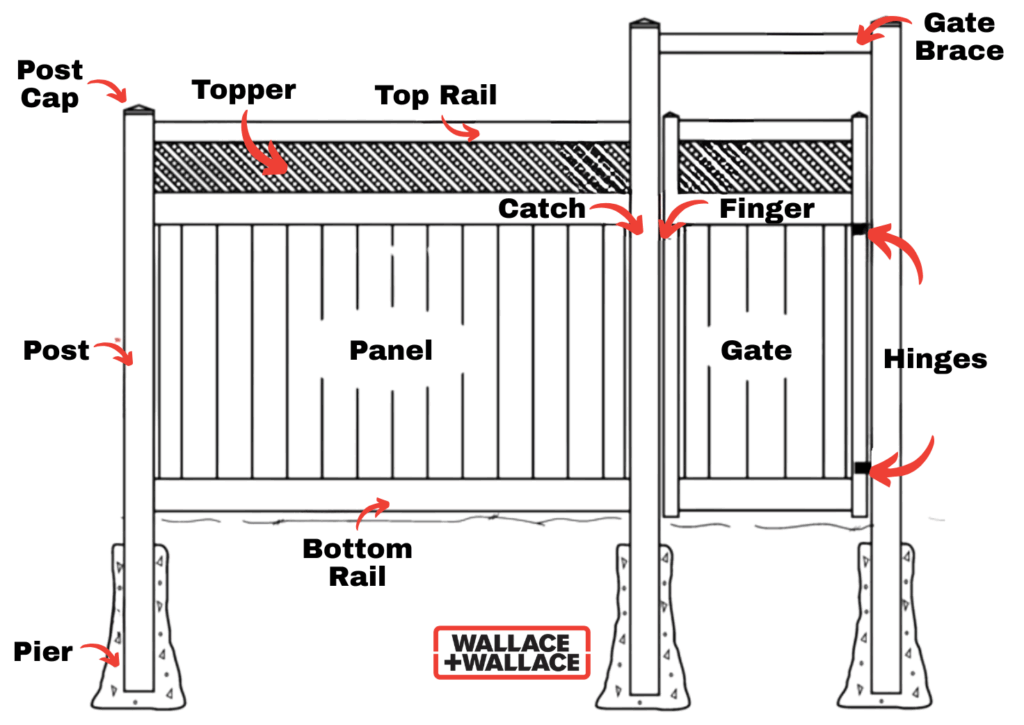
Panel
Think of a panel as one section of your fence, fitting perfectly between two posts. For example, you might say, “That big gust of wind damaged the third panel from the back post!” You’ll hear this term used for wood, vinyl, and welded wire fences, but not for chain link.
Bottom Rail
This is the horizontal piece that runs along the very bottom of your fence. If you have a vinyl fence, the bottom rail usually has a strong metal insert inside to keep it from sagging. For wood fences, the rail on its own is plenty strong! Chain link and welded wire fences don’t typically have bottom rails.
Pier
Some, especially older fence posts might be set into the ground anchored by a cement footing called a pier. If you’re replacing an old fence, you might hear about pier or concrete footing removal. It can be a bit of a mystery, as you never know how big that old pier is until you dig it out! Unless special circumstances demand it, we avoid concrete footings. Setting posts in gravel below the frost line ensures good drainage which minimizes frost heaving. And, avoiding wood posts all together is even better, which is why our preferred method for wood fences is to use steel posts. You can learn more about why in this article.
Post
The posts are truly the backbone of your fence! A well-placed and straight post will keep your entire fence looking fantastic for years to come. Posts are usually spaced about 8 feet apart, but they can be closer if you need extra strength. Generally, the closer they are, the stronger your fence will be.
Post Cap
This is the decorative cover that sits right on top of your fence post. They come in all sorts of styles, sometimes depending on your fence material. For wood fences, post caps can even be “sculpted” right into the post for a unique look!
Topper
A topper is a decorative section that sits above the main body of some fences. Often, fence toppers are made of lattice, which gives you a bit more visibility than the lower part of the fence. Wood fence toppers can be customized to create a truly unique design, while vinyl options are usually more limited. You won’t find toppers on chain link or welded wire fences.
Top Rail
Just like the bottom rail, but this one runs along the top! Unlike vinyl bottom rails, vinyl top rails usually don’t need those metal inserts.
All About Gates: Your Access Point
Gate
The gate is your entry point, giving you access to your yard or the area your fence encloses. For chain link fences, you’ll commonly find single or double-wide swing gates. If you have a wider opening, you might consider a barn track gate or a slide gate. For larger properties or rural areas, automated gates are a fantastic option for convenience and security.
Catch
This is a small but important part of your gate’s hardware system that attaches to the post. It “catches” the gate finger when your gate is closed, keeping it secure, and releases it when you open the gate.
Finger
The finger is the part of the gate hardware that attaches directly to the gate itself. It’s called a “finger” because of its shape! It fits snugly into the catch on the post when your gate is closed.
Gate Brace
Gates put a bit of an uneven load on the posts that hold them. Gate braces are there to give extra support, helping to keep those posts straight and strong. They can also be designed as a decorative accent to the fence line.
Hinges
Just like on a door, hinges allow your gate to swing open and closed smoothly. You can even get self closing hinges, which mean your gate will close all by itself after you’ve opened it. You can also have separate auto-closure mechanisms installed if you prefer.
Want to see how to install a chain link fence? Check out our video series! And if you have more questions, don’t hesitate to contact us. We’re always happy to help.